
There's a moment every backyard cook knows. It's late on a Saturday afternoon. The neighbors are starting to wonder what that smell is. Your kids have given up asking "is it ready yet?" and are just standing around the pit, silently orbiting the heat like moths to a flame. The smoke curls up through the trees. You lift the lid — just a crack — and that rush of sweet, hardwood-scented steam hits you right in the soul. That moment? That's not just dinner. That's culture. It's something older than electricity, older than cities, maybe older than civilization itself.
I grew up watching my grandfather manage a fire like a doctor manages a patient — with patience, intuition, and a sixth sense for when something needed attention. He cooked on a rusted barrel smoker that had no temperature gauge, no fancy dampers, and definitely no Wi-Fi connectivity. But every brisket he pulled off that thing was a masterpiece. The secret wasn't the equipment. It was the philosophy: fire is a conversation, not a switch.
That's why, when I first fired up a Big Green Egg, I felt something I hadn't expected. I felt like he would've loved this thing. Not because it's complicated — it isn't. But because it demands the same respect for fire, the same patience, and rewards you with the same extraordinary results. It just happens to do it with modern precision baked into a design that stretches back millennia.
If you've been on the fence about whether a ceramic kamado grill is right for you — whether a Big Green Egg specifically justifies its premium price tag — this guide is written for you. We're going to dig into the history of this style of cooker, walk through every model and its ideal use case, break down the accessory ecosystem, and give you the honest truth about what it feels like to cook on one. At DNW Outdoors, we don't sell products we don't believe in. The Big Green Egg has earned its spot in our lineup, and here's exactly why.
"BBQ isn't a technique. It's a philosophy. The Big Green Egg is what happens when 5,000 years of accumulated human wisdom about fire and clay finally collides with American obsession."
— DNW Outdoors Editorial Team
Ancient Fire in Modern Form: The Remarkable History of Kamado Cooking
To understand why the Big Green Egg commands such fierce loyalty from its owners — why people call themselves "EGGheads" and join festivals dedicated to cooking on one — you have to understand where this technology comes from. Because unlike gas grills assembled in a factory last year, the design principles inside a Big Green Egg have been refined across three separate continents over roughly 5,000 years.
The Clay Ovens of Ancient China and India
The story begins long before recorded recipes, in the era of the Chinese Qin Dynasty and in the tandoor cultures of ancient India. Archaeologists have uncovered clay cooking vessels that date back over 3,000 years in China — domed clay pots designed to retain heat and moisture in a way that open fires simply couldn't. The physical principle is unchanged today: ceramic absorbs heat slowly, holds it efficiently, and radiates it evenly. This is not a clever modern invention. It's ancient thermodynamics discovered by people who cooked food for survival.
The tandoor — that cylindrical clay oven still used to cook naan bread and tandoori chicken in South Asian restaurants worldwide — is a direct ancestor of the kamado. Remove the modern gas burner from a restaurant tandoor and replace it with hardwood charcoal, and you have something functionally very close to what Japanese cooks were using over a thousand years ago.
The Tandoor Emerges
Clay cooking vessels appear in ancient Chinese and Indian civilizations. The principle of ceramic heat retention is discovered — food cooked inside stays moist, flavor is concentrated, and fuel efficiency is dramatically higher than open fire.
Japan Adopts and Refines
During the Kofun period, Chinese cooking vessel technology arrives in Japan. Japanese cooks adapt the design into the "mushikamado" — a rice steamer with a removable dome lid and a draft door to control airflow and temperature. The word "kamado" means "cooking range" or "stove" in Japanese.
The Raised Platform Era
Japanese craftsmen add a slatted cooking grid and raise the kamado off the floor onto a platform. A device originally designed to steam rice now grills and roasts meat. The fundamental design — dome lid, vented base, ceramic walls — is essentially complete.
American Soldiers Discover the Kamado
U.S. servicemen stationed in Japan encounter these ceramic cookers and are blown away by the flavor and juiciness they produce. Soldiers begin shipping them home as souvenirs. The kamado makes its first appearance in American backyards — a mysterious, egg-shaped clay pot that makes the best ribs anyone has ever tasted.
Ed Fisher Founds Big Green Egg, Inc.
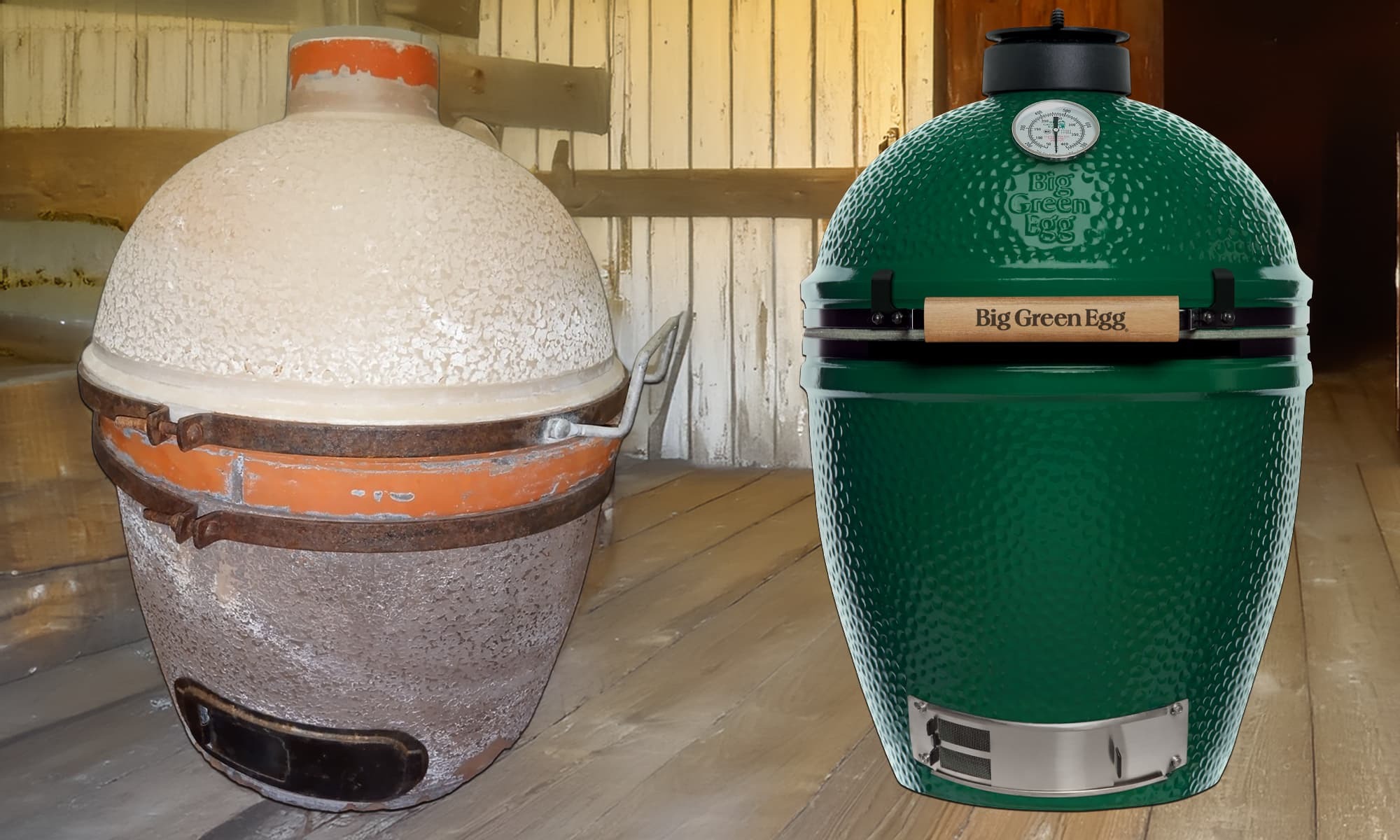
Atlanta entrepreneur Ed Fisher begins importing Japanese mushikamados alongside pachinko machines — Japanese pinball games. He quickly realizes the clay cooker is the real winner. Frustrated by the fragility of imported clay designs, Fisher begins developing his own line using advanced refractory ceramics. Big Green Egg, Inc. is born in Atlanta, Georgia.
The Ceramic Revolution
Big Green Egg introduces aerospace-grade ceramic construction that can withstand temperatures from 70°F ambient cold to over 1,200°F internal heat without cracking. The iconic green glaze is chosen, the patented dual-function rEGGulator vent system is developed, and an entire ecosystem of accessories transforms the EGG into a complete outdoor kitchen.
Why Ed Fisher Painted It Green
It's a question EGGheads love to debate. The original Japanese kamados came in a range of earthy tones — green, black, terracotta orange. Fisher, developing his American-made version in Atlanta in the mid-1970s, chose a distinctive deep forest green. The color became more than a branding decision. It became an identity. Today, that shade of green is as recognizable in the backyard cooking world as a Weber kettle's silhouette or a KitchenAid's profile in the kitchen.
The choice also carried a subtle philosophy: a Big Green Egg belongs outside, in the garden, in nature. It isn't a stainless steel appliance from a hardware store. It's something organic, something that belongs in the same visual world as trees and grass and the smoke rising from a wood fire. That intentional positioning — this isn't just a grill, it's a lifestyle artifact — has defined the brand for 50 years.
Why Serious BBQ Cooks Choose Ceramic Over Everything Else
Before we get into the specific models and accessories, we need to address the fundamental question: why would anyone spend $800–$2,000 on a ceramic grill when a perfectly functional gas grill costs $299 and a quality kettle charcoal grill runs $150? The answer lives in physics, and once you understand it, cheaper alternatives become genuinely hard to justify for anyone serious about flavor.
Moisture Retention
Thick ceramic walls trap humidity inside the cooking chamber. Thin steel cookers vent moisture constantly — your brisket is literally drying out as it cooks. On a kamado, moisture circulates, and the result is meat with a dramatically juicier texture at the same internal temperature.
Temperature Stability
Once ceramic reaches operating temperature, it holds that temperature with extraordinary stability. You can maintain 225°F for a 16-hour overnight smoke without babysitting. Try that on a metal grill — even with electronic controllers, thin walls bleed heat constantly and require constant fuel adjustments.
Extreme Range
The same grill that smokes salmon at 180°F will sear a steak at 750°F. No other single outdoor cooker reliably spans that entire temperature range with equal performance at both ends. A ceramic kamado is genuinely three appliances in one: smoker, grill, and convection oven.
Fuel Efficiency
Because ceramic retains heat so efficiently, a Big Green Egg uses dramatically less charcoal than a metal grill at the same temperature. A long 12-hour smoke on a Large EGG might consume the same amount of lump charcoal that a thin steel smoker burns through in 4 hours. The economics shift over time.
Live Fire Flavor
Lump hardwood charcoal — the only fuel recommended for an EGG — burns cleaner and hotter than briquettes with no chemical binders. The smoke produced by natural wood lump charcoal imparts a complexity of flavor that gas grills physically cannot produce. This is chemistry: the Maillard reaction plus genuine wood smoke equals flavor that cannot be replicated.
Lifetime Durability
Big Green Egg offers a lifetime warranty on their ceramic components. The aerospace-grade ceramics used in modern EGGs won't crack from thermal shock, won't rust, won't corrode, and don't degrade over time. An EGG purchased today will still be cooking in 2075. It is genuinely the last grill you'll ever need to buy.
The Science Behind Kamado Heat
Standard steel grills have walls measured in millimeters. A Big Green Egg's ceramic shell is over an inch thick. This mass gives the EGG extraordinary thermal inertia — once hot, it resists temperature changes the way a cast iron skillet holds heat compared to a thin aluminum pan. When you open the lid on a steel grill, temperature drops 100°F in seconds. Open an EGG at cooking temperature and it recovers within minutes. This isn't a feature — it's fundamental physics, and it changes everything about how you manage a long cook.
The Complete Big Green Egg Lineup: Finding Your Perfect Size
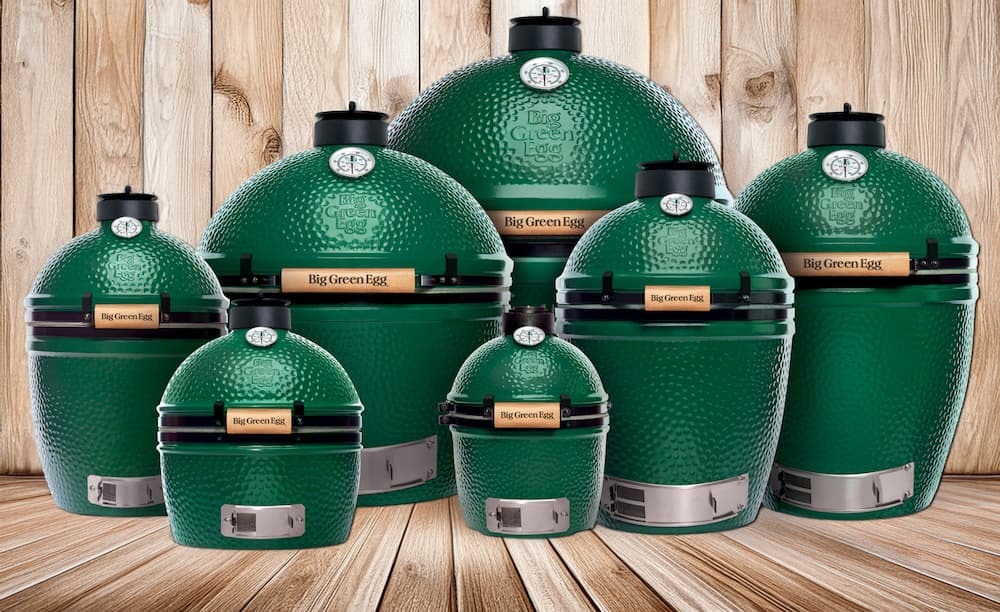
One of the most common rookie mistakes with the Big Green Egg is choosing the wrong size. Buy too small and you're frustrated every time you want to feed a crowd. Buy too large and you're burning through charcoal to heat more ceramic than you actually need. Here's an honest breakdown of every current model and who it's genuinely right for.
| Model | Grid Size | Cooking Area | Best For | Capacity |
|---|---|---|---|---|
| Mini | 10 in / 25 cm | 79 sq in | Solo camping, tabletop, gifts | 1–2 people |
| MiniMax | 13 in / 33 cm | 133 sq in | Tailgating, balconies, camping | 2–4 people |
| Small | 13 in / 33 cm | 133 sq in | Urban patios, restaurants, companion EGG | 2–4 people |
| Medium | 15 in / 38 cm | 177 sq in | Couples, small families, apartment living | 3–5 people |
| Large Most Popular | 18.25 in / 46 cm | 262 sq in | Family BBQ, entertaining, most cooks | 4–8 people |
| XLarge | 24 in / 61 cm | 452 sq in | Large gatherings, competition BBQ | 8–15 people |
| 2XLarge | 29 in / 74 cm | 672 sq in | Catering, events, serious pitmasters | 15–20+ people |
The Large EGG: The Sweet Spot for Most Cooks
If you're reading this as a home cook who entertains occasionally and wants a serious everyday grill, the Large Big Green Egg is almost certainly your answer. It's the most popular size sold worldwide, and for good reason: the 18.25-inch cooking grid fits a full packer brisket, a 20-pound turkey, a dozen burgers at once, or multiple racks of ribs. It's large enough to be genuinely useful for a party, compact enough to heat efficiently for a Tuesday night steak.
The MiniMax: The Traveler's EGG
Don't let the compact footprint fool you. The MiniMax packs 133 square inches of cooking area — enough for a whole chicken, 4 burgers, or a rack of ribs — into a unit that weighs 76 pounds and ships with a dedicated carrier handle. This is the EGG for tailgating at the game, camping in the woods, cooking poolside, or anyone whose outdoor space is measured in square feet rather than acres. It runs on the same aerospace ceramics and delivers identical performance to its larger siblings. Many serious EGGheads own both a Large and a MiniMax — one for home, one for everywhere else.
The XLarge: When Size Matters
If you regularly cook for a crowd of eight or more, or if competition BBQ is your calling, the XLarge's 452 square inches opens up capabilities unavailable on smaller models. You can run a full 6-rack rib setup with an EGGspander system. You can smoke two full briskets simultaneously. You can entertain 20 people and have food on the table at the same time — the dream that every backyard pitmaster chases.
The EGG Accessory Ecosystem: Turning One Grill Into a Complete Outdoor Kitchen
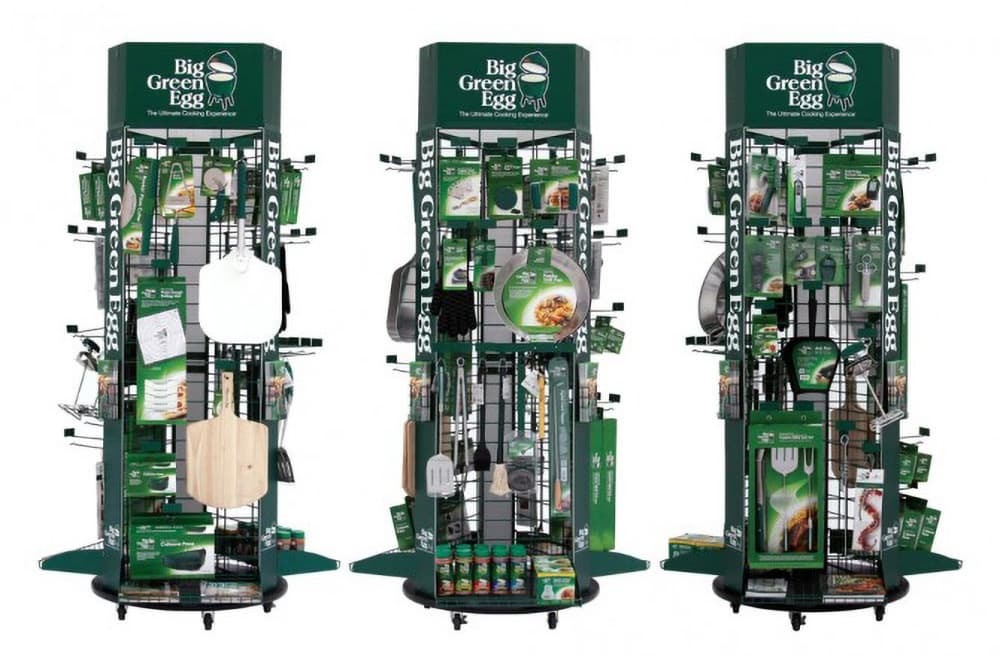
One of the most compelling arguments for investing in a Big Green Egg over competing kamado brands is the depth and quality of the Big Green Egg accessory ecosystem. This is not an afterthought collection of add-ons. It's a thoughtfully engineered system of components that have been developed and refined over five decades, each designed to unlock a specific cooking capability.
With the right combination of accessories, a single Big Green Egg replaces your grill, your smoker, your pizza oven, your Dutch oven, your wok station, and your rotisserie. That's not marketing hyperbole. That's the honest reality that every long-term EGGhead will confirm.
The EGGspander System
The game-changing multi-level cooking framework that effectively doubles your cooking surface. Allows simultaneous cooking at different temperatures — sear a steak at 600°F on the lower grid while baking potatoes at 375°F above it. A fundamental upgrade for any EGG owner who wants to cook a full meal simultaneously.
Pizza & Baking Stones
The ceramic baking stone transforms your EGG into a wood-fired pizza oven capable of reaching 700°F+ cooking temperatures. The stone heats evenly, wicks moisture from the crust, and produces a leopard-spotted, blistered Neapolitan pizza that rivals any dedicated pizza oven costing three times as much.
The rEGGulator Vent Cap
Big Green Egg's patented dual-function vent system allows precise temperature control from 70°C (for cold-smoking fish) to 350°C+ (for high-heat searing). Understanding the rEGGulator is the foundation of kamado mastery — top and bottom vents work in concert to manage airflow, and with practice, you'll dial in any temperature within minutes.
Cast Iron Cooking Grids
Cast iron retains and radiates heat differently than stainless steel, creating a more aggressive sear with deeper grill marks. For steakhouse-quality crust formation — the Maillard reaction at its absolute peak — a cast iron grid at 700°F produces results that justify the upgrade on their own. Essential for high-heat cooks.
Plate Setter / ConvEGGtor
The ceramic heat deflector plate that converts your EGG from a direct-heat grill to an indirect convection cooker. This is how you smoke ribs, brisket, whole chickens, and turkeys — the plate deflects direct flame upward while convective heat circulates around the food. Absolutely essential for low-and-slow cooking.
Wood Chip & Chunk Flavoring
Big Green Egg lump charcoal provides a neutral hardwood base. Specialty smoking woods — hickory for pork, cherry for poultry, mesquite for beef, applewood for fish — added directly to the charcoal impart specific flavor profiles. Understanding wood pairing is the difference between "smoked food" and "perfectly smoked food."
Modular Nests & Tables
Big Green Egg's modular furniture system includes cedar and cypress tables with built-in side shelving, stainless steel Egg Mates, and rolling nests that allow you to move your EGG around your outdoor space. The interlocking system means you can start with a basic nest and expand as your outdoor kitchen grows.
Digital Temperature Controllers
Third-party and BGE-compatible fan-based temperature controllers (like the CyberQ and PartyQ) attach to the bottom vent and automate airflow management. For overnight smokes — 14-hour briskets that run from midnight to noon — a temperature controller gives you the freedom to actually sleep without sacrificing your cook.
What You Can Actually Cook: Beyond the Burger
The single biggest misconception about the Big Green Egg — especially among people who've never cooked on one — is that it's a premium charcoal grill. That framing misses the point almost entirely. Yes, it makes exceptional burgers and steaks. But that barely scratches the surface of what this cooker is capable of.
Low and Slow BBQ: The Holy Grail
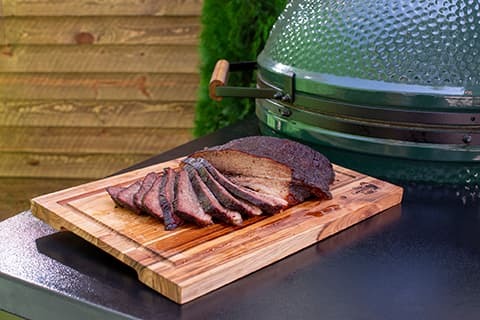
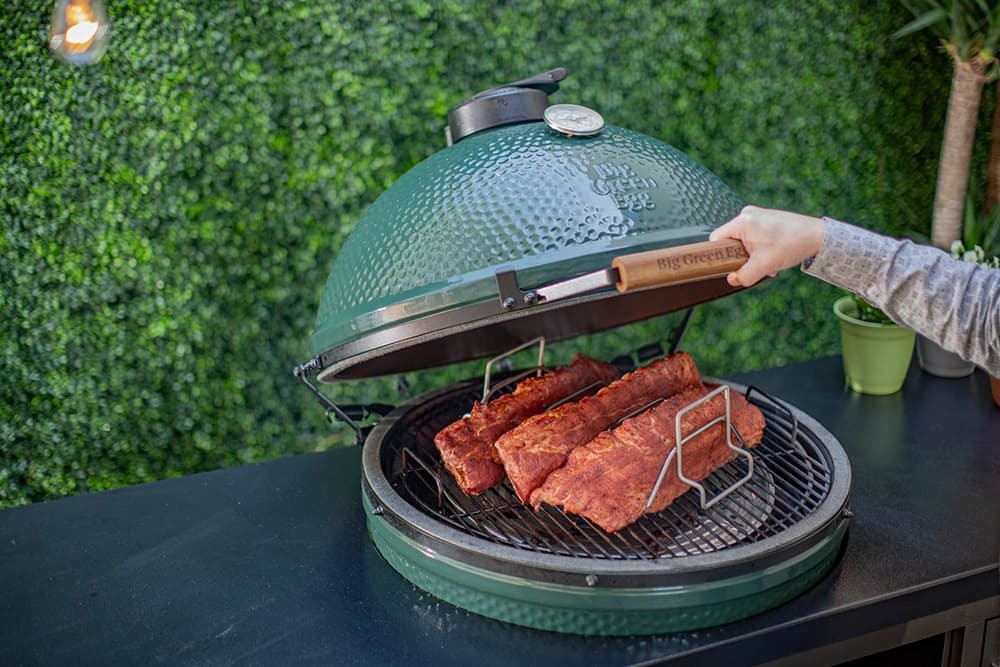
This is where the kamado design proves its mastery. Set up with a ConvEGGtor plate, a full basket of lump charcoal, and proper vent settings, a Big Green Egg will maintain 225°F for 16–18 hours with the stability of a laboratory oven. The ceramic walls trap moisture, the hardwood lump charcoal burns slow and clean, and the result — a 14-pound packer brisket with a full smoke ring, bark as dark as midnight, and interior fat that has fully rendered into the grain of the meat — is a religious experience. This is competition-quality barbecue in your backyard, achievable by a complete beginner willing to follow proper technique.
High-Heat Searing and Steakhouse Crust
Open the vents fully on a Big Green Egg loaded with lump charcoal and you will reach 650–750°F within 20 minutes. At that temperature, a 1.5-inch dry-aged ribeye develops a Maillard crust in 90 seconds per side. The cast iron grid sears a pattern deep into the meat surface. The fat renders and flames — briefly — creating that smoke-kiss that defines great steakhouse flavor. No gas grill at any price point produces this result, because gas simply doesn't concentrate radiant heat the way a nearly-enclosed ceramic firebox does.
Wood-Fired Pizza
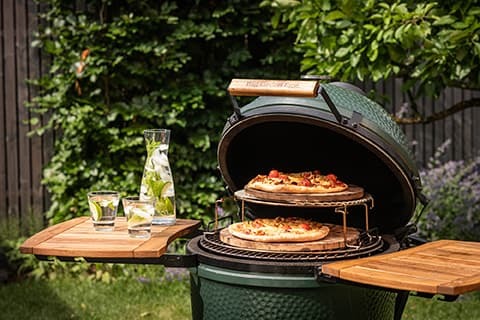
Preheat the EGG to 600°F+ with a baking stone inside, let the stone fully absorb the heat for 30 minutes, and you have a wood-fired pizza environment that rivals a dedicated Neapolitan pizza oven. The ceramic ceiling of the dome radiates heat downward onto the top of the pizza while the stone fires the crust from below. A 10-inch pizza cooks in 4–5 minutes with a perfectly charred cornicione, bubbled cheese, and a crisp bottom that snaps when you fold it. Pizza on a Big Green Egg is one of those unexpected discoveries that makes you wonder why you ever ordered delivery.
Baking: Bread, Pies, and More
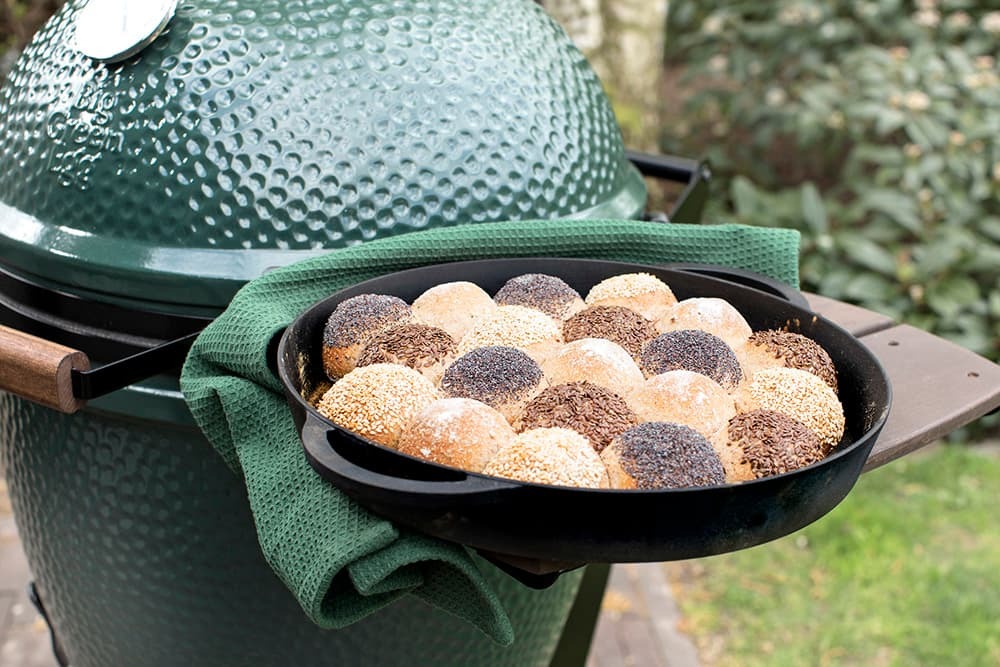
The same convective heat that makes kamado low-and-slow cooking so superior also produces extraordinary baked goods. Sourdough baked inside a Big Green Egg develops a crust with a crackle and depth impossible in a home electric oven. Fruit pies come out with caramelized filling and a butter crust that your kitchen oven simply cannot replicate. This is not theoretical — the EGG's dome shape creates a natural convection environment that behaves more like a traditional wood-fired bread oven than any modern kitchen appliance.
What Owning a Big Green Egg Actually Feels Like
Let me be honest with you about something that rarely shows up in product reviews: the Big Green Egg changes how you think about food. Not gradually, over years — but within the first three or four cooks. The experience of producing something extraordinary from an outdoor fire, without special training or professional equipment, is genuinely transformative.
You'll start planning your weekends around cooks. You'll find yourself researching wood chip pairings at midnight. You'll develop opinions about lump charcoal brands. You'll be up at 6 AM on a Sunday, not because you have to be, but because you put a pork shoulder on at 11 PM the night before and you're genuinely excited to check the bark formation. This is the part nobody warns you about: the Big Green Egg is not just a grill. It becomes a hobby.
"The difference between a gas grill cook and a kamado cook is the same as the difference between a microwave user and a chef. One produces heat. The other builds a relationship with fire."
— Veteran EGGhead, posted to the EGGhead ForumThe Learning Curve Is Real — and Worth It
Fair warning: the Big Green Egg has a steeper initial learning curve than a gas grill. Learning to manage the dual vent system, understanding how to light lump charcoal properly, knowing when the ceramic is truly up to temperature — these are skills developed over your first dozen cooks. The most common beginner mistake is adding too much charcoal, opening the lid too frequently, and fighting the EGG's natural tendencies rather than learning to work with them. The good news: the EGGhead community is extraordinarily generous with knowledge, and there are decades of tutorials, forums, and recipe resources available. By your fifth cook, you'll wonder what was ever confusing.
The Warranty That Means Something
Big Green Egg's lifetime warranty on ceramic components isn't a marketing tagline — it's a reflection of genuine confidence in the product's durability. The aerospace-grade ceramics used in the EGG won't crack from thermal shock, won't rust through a winter, and won't warp under high heat. In a world of planned obsolescence, a Big Green Egg is genuinely designed to outlast its owner. Buy one in 2025 and your kids might still be cooking on it in 2065. That's not a figure of speech.
Big Green Egg vs. The Competition: An Honest Assessment
The kamado category has exploded over the past decade, and Big Green Egg now faces legitimate competition from Kamado Joe, Vision Grills, Primo, and others. We believe in honest comparisons, so here's where the EGG genuinely leads — and where competitors have closed the gap.
Where Big Green Egg Leads
Dealer network and resale value. No other kamado brand approaches BGE's certified dealer infrastructure, which means in-person expertise, hands-on demonstrations, and warranty service you can actually access. Big Green Eggs also hold their resale value better than almost any other outdoor cooking equipment — a 10-year-old EGG in good condition still sells for 60–70% of original retail. The accessory ecosystem depth is also unmatched: 50 years of accessory development means there's a BGE-specific solution for virtually every cooking technique imaginable.
Where Competitors Have Caught Up
Kamado Joe in particular has introduced innovations — the Divide & Conquer cooking system, the SloRoller insert for cyclone-flow smoking, the DoJoe pizza adapter — that are genuinely compelling. If you're buying your first kamado today, Kamado Joe deserves a serious look alongside the EGG. That said, for long-term accessory compatibility, dealer support, and brand community, the Big Green Egg still represents the most proven choice in the ceramic kamado category.
Our Recommendation at DNW Outdoors
For most backyard cooks who want a single grill that does everything exceptionally well, the Large Big Green Egg remains our top recommendation. Pair it with a ConvEGGtor, a pizza stone, and a bag of premium lump charcoal, and you have an outdoor cooking setup that will produce extraordinary results for decades.
For cooks who entertain frequently or want to pursue competition BBQ, step up to the XLarge. For apartment dwellers, balcony grillers, or anyone who needs a take-everywhere option, the MiniMax is a revelation.
Getting Started: Your First Cook on a Big Green Egg
If you've gotten this far and you're ready to take the plunge, here's the practical roadmap for your first session — the advice we wish someone had given us at the beginning.
Light It Right
Use natural fire starters — BGE-branded starters or paper-based alternatives work well. Never use lighter fluid or chemical accelerants on a ceramic kamado. Fill the firebox to the top of the fire ring with lump charcoal, nest two or three fire starters in the charcoal, and light them. Leave the dome open and both vents fully open for the first 10–15 minutes while the fire establishes. You'll see smoke — white at first, then clearing to almost invisible as the charcoal comes up to heat. Wait for the smoke to clear before you think about cooking.
Temperature Control Is Everything
Once you're within 50°F of your target temperature, begin closing the vents in small increments. It's always easier to raise temperature than lower it — the ceramic retains heat and resists cooling. Approach your target temp slowly, from below. For a 225°F smoke, start closing down when you hit 200°F and nudge upward carefully. For a 600°F pizza cook, open everything up and let it rip.
Your First Cook: Keep It Simple
We recommend starting with a whole spatchcocked chicken. It's forgiving, it rewards moisture-retaining indirect cooking, and it's done in about 60–75 minutes at 375°F — fast enough that you don't need to manage an overnight cook on your first session. By the time that chicken comes off the EGG with crackling crispy skin and juices running clear, you'll understand exactly what makes this grill different. And you'll already be planning what to cook next.